
If you’ve spent any time in Japan, you’ve probably heard people say どうも (doumo).
Sometimes it sounds like “thank you.”
Sometimes it sounds like “hello.”
And sometimes it appears before another phrase, like どうもありがとう or どうもすみません.
So what does doumo actually mean?
The tricky part is that there isn’t just one English translation.
Depending on the situation, どうも can mean “thanks” or work as an intensifier that adds emphasis to gratitude, an apology, or even a greeting.
Instead of trying to memorize one English translation, it’s easier to understand what doumo does in a Japanese sentence.

What Does Doumo Actually Do?
One common function of どうも is to add emphasis to what follows.
Think of it as adding a feeling like:
really / very / very much
For example:
ありがとう
Arigatou
Thank you.
Add どうも:
どうもありがとう。
Doumo arigatou.
Thank you very much.
The word itself hasn’t simply become “thank you.”
Instead, どうも makes the feeling of gratitude stronger.
But Japanese people also use どうも by itself, especially in casual conversation.
That’s why the word can feel confusing to Japanese learners.
Let’s look at how it actually works.
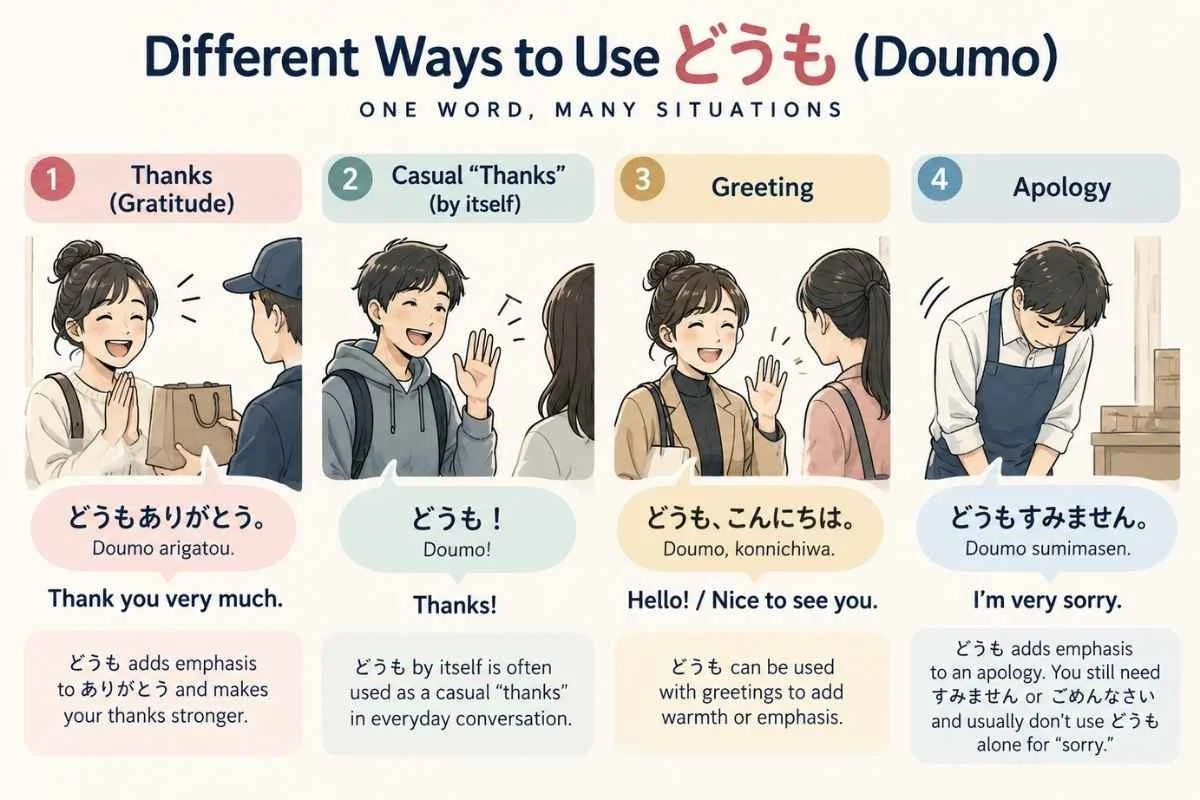
1. Doumo for Gratitude
This is probably one of the most common ways you’ll hear どうも.
どうもありがとう。
Doumo arigatou.
Thank you very much.
Here, どうも adds emphasis to ありがとう.
You can make it more polite by saying:
どうもありがとうございます。
Doumo arigatou gozaimasu.
Thank you very much.
This is a very useful expression when you want to show sincere appreciation.
2. Can Doumo by Itself Mean “Thanks”?
Yes.
In casual conversation, Japanese people often shorten the expression and simply say:
どうも。
Doumo.
Thanks.
For example, someone hands you something, holds a door for you, or does a small favor.
You might simply respond:
どうも!
In this situation, translating it as “Thanks!” sounds natural in English.
But remember: that doesn’t mean the dictionary definition of どうも is simply “thank you.”
Its meaning depends heavily on the situation.
3. Doumo in Greetings
You may also hear どうも used with greetings.
For example:
どうも、こんにちは。
Doumo, konnichiwa.
Hello! / Nice to see you.
Or when meeting someone:
どうも、はじめまして。
Doumo, hajimemashite.
Nice to meet you.
Here again, どうも adds warmth or emphasis to the greeting.
And sometimes Japanese people simply say:
どうも。
Depending on the situation and tone, this can function as a casual greeting—something like:
“Hi.”
That’s one reason translating どうも into a single English word can be so difficult.
4. Doumo with an Apology
You can also use どうも to strengthen an apology.
どうもすみません。
Doumo sumimasen.
I’m very sorry.
You may also hear:
どうもごめんなさい。
Doumo gomennasai.
I’m really sorry.
Here, どうも adds emphasis to the apology.
But there is an important difference.
When expressing thanks, どうも can often stand by itself:
どうも!
Thanks!
But you normally wouldn’t use どうも alone to mean “sorry.”
For an apology, you still need an expression such as すみません or ごめんなさい.
So, Does Doumo Mean “Thank You”?
Sometimes—but not exactly.
This is where Japanese gets interesting.
If someone says:
どうも!
and you translate it as:
“Thanks!”
that may be completely correct in that situation.
But どうも itself doesn’t always mean “thank you.”
Look at these examples:
どうもありがとう。
Doumo arigatou.
Thank you very much.
どうもすみません。
Doumo sumimasen.
I’m very sorry.
どうも、こんにちは。
Doumo, konnichiwa.
Hello! / Nice to see you.
Same どうも.
Different English.
That’s why context matters so much.
Is Doumo Casual or Polite?
どうも by itself is generally casual.
You might use it for a quick “thanks” with someone you know, at a shop, or in another relaxed everyday situation.
When you want to be more polite or express stronger gratitude, it’s safer to use the complete expression:
どうもありがとうございます。
Doumo arigatou gozaimasu.
Thank you very much.
For Japanese learners, this is more useful than simply adding です to どうも.
You may occasionally hear expressions such as どうもです in casual spoken Japanese, but I wouldn’t recommend thinking of it as the standard “polite version” of どうも.
Why Is Doumo So Hard to Translate?
Because Japanese and English don’t always divide meaning in the same way.
We naturally want to learn vocabulary like this:
ありがとう = thank you
こんにちは = hello
すみません = sorry / excuse me
But どうも doesn’t fit neatly into that kind of vocabulary list.
Its meaning changes depending on:
what comes after it
the situation
the relationship between the speakers
the speaker’s tone
That’s why listening to どうも in real sentences is much more useful than memorizing one English translation.
Moto’s Tip 🇯🇵
Don’t try too hard to memorize:
どうも = ______
There isn’t one perfect English word to put in that blank.
Instead, listen to what comes after どうも and pay attention to the situation.
If someone says:
どうもありがとう
you’ll hear gratitude.
If someone says:
どうもすみません
you’ll hear an apology.
And if someone smiles and simply says:
どうも!
it might just mean:
“Thanks!”
That flexibility is exactly what makes どうも such a useful—and very Japanese—expression.
どうもありがとうございました!
Doumo arigatou gozaimashita!
Thanks very much for reading!
If you’re learning Japanese, don’t worry about translating every Japanese word perfectly into English.
Sometimes the best way to understand Japanese is to learn how people actually use it.
Good luck with your Japanese! 🇯🇵




Itadakimasu (いただきます) is often translated as “Let’s eat,” but its real meaning goes much deeper. Discover where the word comes from and how this simple phrase expresses gratitude for the food, nature, and people behind every meal.