
How to Start Learning Japanese: A Simple Beginner Roadmap
So, you want to learn Japanese?
👏Great!
Then you start searching online and suddenly you have 15 apps, three YouTube channels, five textbooks, flashcards, kanji lists…and no idea where to actually begin.
You don’t need all of that.
You just need a place to start.
Here’s the simple path I recommend for beginners.
Step 1: Get One Good Textbook
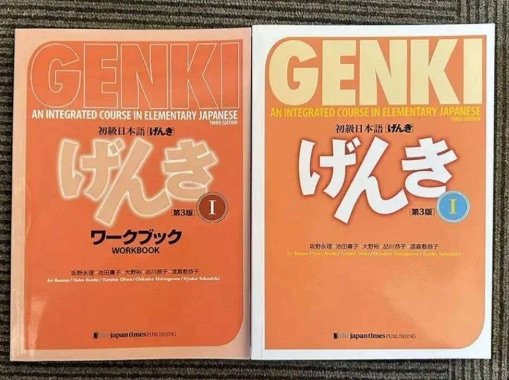
You don’t need five different textbooks.
Pick one and use it as the backbone of your Japanese study.
For most beginners, I recommend GENKI I: An Integrated Course in Elementary Japanese.
GENKI gives you a clear order to follow: vocabulary, grammar, reading, writing, and exercises. You can use the physical book or an official digital edition if available to you.
MOTO TIP: Don’t purchase one right away. Find a free download online! If you really like it and think you want one, then buy.
The important thing is not to collect Japanese-learning resources.
Pick one. Start. Keep going.
Then use resources like Motokyo when you need another explanation or some extra practice.
Step 2: Learn Hiragana — and Write It
Before worrying about kanji, start with hiragana.
Hiragana is one of the basic writing systems used in Japanese, and you’ll see it everywhere.
You can certainly use an app to memorize the characters, but I strongly recommend actually writing them by hand.
Why?
Because Japanese characters aren’t just shapes.
The direction of the strokes, the order you write them, and the movement of your hand all help you understand how the character is formed.
Don’t worry about making your hiragana beautiful at first.
Write it.
Say the sound.
Write it again.
Start here on Motokyo
Download the free Motokyo Hiragana Practice PDF and practice writing the characters yourself.
Once you begin recognizing hiragana without having to think about every character, you’re ready to move forward.
You do NOT have to wait until your hiragana is perfect.
And quiz yourself using Motokyo Hiragana and Katakana Quiz.
Step 3: Start Learning Basic Sentence Structure
Now we can actually make some Japanese.
This is where I think beginners sometimes make Japanese harder than it needs to be.
Don’t try to memorize hundreds of random words first.
Learn how a Japanese sentence works.
For example:
わたしは学生です。
Watashi wa gakusei desu.
I am a student.
Once you understand the basic structure, you can start changing pieces of the sentence and making your own Japanese.
As you work through GENKI, use the Beginner Japanese Lessons on Motokyo when you want another explanation.
You can explore topics such as:
Basic Japanese sentence structure
は (wa) vs. が (ga)
です (desu)
Japanese verbs
い and な adjectives
あります and います
Te-form
Counters
You don’t need to understand every grammar rule immediately.
Learn one pattern.
Use it.
Then add another.
Step 4: Learn Vocabulary in Context
Of course, you need vocabulary.
But try not to turn Japanese into one giant memorization exercise.
Instead of only learning:
たべる = to eat
try learning it inside Japanese:
すしをたべます。
Sushi o tabemasu.
I eat sushi.
Now you’re learning vocabulary AND how Japanese works at the same time.
If you’re studying with GENKI, you can also use the Motokyo GENKI Vocabulary Quizzes to check what you remember from each lesson.
You’ll also find other practice quizzes on Motokyo for kana, counters, vocabulary, and beginner Japanese.
Study a little.
Test yourself.
See what you forgot.
Then try again.
That’s learning.
Step 5: Learn Katakana
Once you’re comfortable with hiragana, start learning katakana.
Katakana is especially important because Japanese uses it constantly for words borrowed from other languages.
For example:
コーヒー — coffee
テレビ — television
ホテル — hotel
レストラン — restaurant
You’ll probably recognize more Japanese than you expect once you can read katakana.
And yes — write katakana by hand too.
The same principle applies.
Step 6: Start Kanji Small
This is the part that scares a lot of beginners.
Kanji.
Don’t try to memorize 2,000 kanji.
Not yet.
Start with a few simple, useful characters:
一 — one
二 — two
三 — three
人 — person
日 — day / sun
月 — month / moon
Learn what they mean, how they’re written, and where you actually see them.
Then slowly build from there.
Ten kanji becomes 20.
Twenty becomes 50.
You have time.
Step 7: Listen to Real Japanese From the Beginning
There’s one more thing I want you to do early:
Listen to Japanese.
Even when you don’t understand everything.
Listen to how Japanese actually sounds. Notice the rhythm. Notice expressions that keep coming back.
Because the Japanese you learn in a textbook and the Japanese you hear in Japan are not always exactly the same.
For example, what does やばい (yabai) really mean?
Why do Japanese people say やっぱり (yappari) so often?
What does よろしくお願いします (yoroshiku onegaishimasu) actually mean when there isn’t a perfect English translation?
Why does 行く (iku) sometimes feel like “come” to an English speaker?
These are the kinds of things I explain in Japanese You Actually Hear on Motokyo.
Your textbook teaches you the foundation.
Then real Japanese makes it come alive.
Your Simple Japanese Roadmap
If all of this still feels like a lot, forget everything else and follow this:
1. Get GENKI I
↓
2. Learn Hiragana + download the Motokyo Hiragana Practice PDF
↓
3. Start GENKI Lesson 1
↓
4. Use Motokyo Beginner Lessons when you need help
↓
5. Practice with the Motokyo vocabulary and Japanese quizzes
↓
6. Learn Katakana
↓
7. Start learning a few Kanji
↓
8. Listen to Japanese and explore Japanese You Actually Hear
That’s it.
You don’t need 10 apps.
You don’t need to know 2,000 kanji before you can say anything.
And you definitely don’t need to wait until you feel “ready.”
Ready? Start Here.
If you’re completely new to Japanese, your first step is simple:
Grab the Motokyo Hiragana Practice PDF, pick up a pencil, and start writing.
Then come back and keep going.
I’ll help you with the Japanese that textbooks teach — and some of the Japanese they don’t.
Let’s start learning Japanese.