
Japanese Particles Explained Simply: は, が, の, を, に, で
Japanese particles can feel confusing when you first start learning Japanese.
は? が? に? で?
They’re tiny, but they seem to be everywhere.
The good news is: you don’t need to understand every Japanese particle at once.
If you’re just starting Japanese, begin with these six:
は (wa) ・ が (ga) ・ の (no) ・ を (o) ・ に (ni) ・ で (de)
Once you understand what each one is doing, Japanese sentences start making a lot more sense.
Let’s keep it simple.
First: What is a Japanese particle?
Particles are small words that come after a word and tell you what role that word has in the sentence.
For example:
わたしは日本人です。
Watashi wa nihonjin desu.
I am Japanese.
The particle は (wa) tells us:
👉 “We’re talking about わたし (watashi).”
Think of particles as little signs inside a Japanese sentence.
They tell you how the pieces connect.
1. は (wa) — What are we talking about?
は marks the topic of the sentence.
わたしはモトです。
Watashi wa Moto desu.
I’m Moto.
The topic is わたし — me.
Another example:
ラーメンはおいしいです。
Rāmen wa oishii desu.
Ramen is delicious.
We’re talking about ramen.
Moto’s Tip
A helpful way to understand は (wa) is to think:
“As for…” or “Speaking of…”
For example:
ラーメンはおいしいです。
Rāmen wa oishii desu.
Ramen is delicious.
Think of it as:
“As for ramen, it’s delicious.”
or
“Speaking of ramen, it’s delicious.”
You don't need to translate は this way every time. It's simply a way to feel what は is doing.
は sets the topic — it tells the listener what we're talking about.
2. が (ga) — Who or what?
This is where beginners often get confused.
Both は and が can appear after a noun, but they don't do exactly the same job.
が often identifies WHO or WHAT.
Someone asks:
だれが来ますか?
Dare ga kimasu ka?
Who is coming?
You answer:
たなかさんが来ます。
Tanaka-san ga kimasu.
Tanaka is coming.
Who? → Tanaka.
That new information is marked with が.
Moto’s Tip
Don’t try to master は vs. が in one day.
A useful beginner shortcut is:
は → What are we talking about?
が → Who/what is it?
There are more nuances later, but this is a good place to start.
3. の (no) — Connect two nouns
の is one of the easiest and most useful Japanese particles.
It connects one noun to another noun.
わたしの名前
Watashi no namae
My name
日本の食べ物
Nihon no tabemono
Japanese food / food of Japan
東京のラーメン
Tōkyō no rāmen
Tokyo ramen
Here’s the important part:
The word before の describes the word after の.
日本 の 食べ物
Japan → tells us what kind of → food
Moto’s Tip
Don’t memorize の = “’s.”
Sometimes it works:
モトのラーメン
Moto no rāmen
→ Moto’s ramen
But English connects nouns in many different ways:
東京のラーメン
Tōkyō no rāmen
→ Tokyo ramen
しょうゆのラーメン
Shōyu no rāmen
→ Shoyu ramen
日本の文化
Nihon no bunka
→ Japanese culture
The English changes, but the Japanese pattern stays the same:
A の B
A tells you what kind of B we're talking about.
And here's the key: find the variety.
Look at B first.
東京のラーメン → It’s ramen. What kind? → Tokyo ramen.
しょうゆのラーメン → It’s ramen. What kind? → Shoyu ramen.
日本の文化 → It’s culture. What kind? → Japanese culture.
4. を (o) — What are you doing it to?
を marks the object of an action.
ラーメンを食べます。
Rāmen o tabemasu.
I eat ramen.
What do you eat?
Ramen.
コーヒーを飲みます。
Kōhī o nomimasu.
I drink coffee.
What do you drink?
Coffee.
Moto’s Tip
Although it is written を (wo), in modern Japanese it is normally pronounced simply:
“o.”
So:
ラーメンを食べます
sounds like:
rāmen o tabemasu.
5. に (ni) — Destination, time, and more
に has several uses, so don’t worry about memorizing all of them immediately.
Two very useful beginner uses are destination and time.
Destination
東京に行きます。
Tōkyō ni ikimasu.
I’m going to Tokyo.
Where are you going?
Tokyo → に
Time
7時に起きます。
Shichi-ji ni okimasu.
I wake up at 7:00.
When?
7:00 → に
For now, think of に as often pointing toward a specific destination or point in time.
6. で (de) — Where does the action happen?
Here’s another particle beginners often mix up with に.
で can mark the place where an action happens.
レストランで食べます。
Resutoran de tabemasu.
I eat at a restaurant.
東京で買い物します。
Tōkyō de kaimono shimasu.
I shop in Tokyo.
The action happens there.
Moto’s Tip
A simple way to remember に vs. で:
東京に行きます。
I go to Tokyo.
東京で食べます。
I eat in Tokyo.
👉 に = destination
👉 で = where the action happens
That distinction will get you surprisingly far.
Put Them Together
Now look at this sentence:
わたしは東京でラーメンを食べます。
Watashi wa Tōkyō de rāmen o tabemasu.
I eat ramen in Tokyo.
Instead of seeing one long Japanese sentence, break it into pieces:
わたし は
As for me...
東京 で
in Tokyo...
ラーメン を
ramen...
食べます
eat.
Suddenly the sentence isn't so mysterious.
The particles are showing you how everything fits together.
The 6 Japanese Particles to Remember First
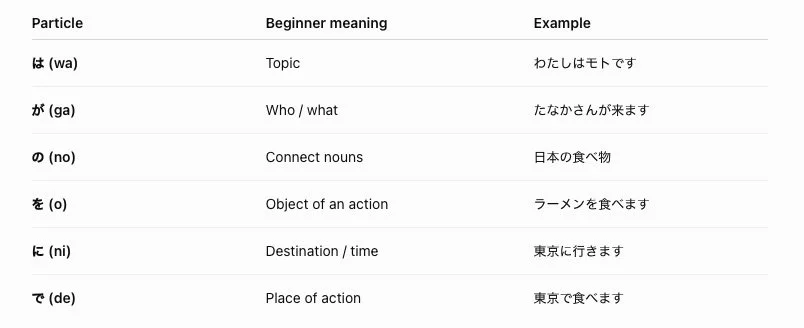
You don't need to memorize every rule today.
Start noticing these six particles when you read or hear Japanese.
The more Japanese you see, the more natural they will start to feel.
Keep Learning Japanese!
If you're just getting started, don't jump randomly from grammar point to grammar point.
Start with the basics and build from there.
→ How to Start Learning Japanese
Then continue through the Motokyo Beginner Japanese Lessons, where we build Japanese one step at a time.
And remember:
You don't need to understand everything before you start using Japanese.
Learn a little. Use it. Then add another piece.