
Learn Hiragana & Katakana: Start Reading Japanese
If you're just starting to learn Japanese, this is where I want you to begin.
Hiragana.
Japanese writing can look intimidating at first. You may have heard about hiragana, katakana, and kanji and wondered:
Do I really have to learn all of this?
Eventually, yes.
But not today.
Let’s start with hiragana.
Step 1: Start With Hiragana
Hiragana (ひらがな) is one of the basic Japanese writing systems.
There are 46 basic hiragana characters, and each one represents a sound.
For example:
あ — a
い — i
う — u
え — e
お — o
When you first start, you may be tempted to memorize them by looking at a chart over and over.
I recommend something different:
Write them.
Write Hiragana to Learn Hiragana
Japanese children learn hiragana by writing it again and again.

There’s a reason for that.
When you write a character, you’re learning more than its shape. You begin to notice where the stroke starts, which direction it moves, and how the different parts connect.
So grab a pencil.
Say the sound as you write:
あ — a
い — i
う — u
Don't worry about making your hiragana beautiful yet.
The goal is to connect the sound + shape + movement.
Get Your Free Hiragana & Katakana Practice Sheets!
Ready to start writing Japanese?
Download my free printable Hiragana & Katakana practice sheets and practice writing Japanese at your own pace.
Enter your email below to get your free practice sheets!
No spam—just occasional Japanese language, culture, and travel tips from Motokyo.
What About Romaji?

Romaji is Japanese written using the Roman alphabet.
For example:
すし → sushi
ありがとう → arigatou
Romaji can be very helpful when you're just starting.
But think of it as a bridge — not the destination.
If you always depend on romaji, your eyes naturally go to the English letters instead of the Japanese.
At first:
すし → sushi
Eventually, the goal is simply:
すし
…and you know how to read it.
So use romaji when you need it, but slowly start letting it go as your hiragana improves.
Step 2: Learn Katakana
Once you're getting comfortable with hiragana, move on to katakana (カタカナ).
Katakana represents the same basic sounds as hiragana, but it uses different characters.
For example:
あ → ア
い → イ
う → ウ
え → エ
お → オ
So why does Japanese need another alphabet?
Katakana is commonly used for words borrowed from other languages.
You'll see it everywhere in Japan.
コーヒー — coffee
ホテル — hotel
テレビ — television
レストラン — restaurant
Once you learn katakana, you'll suddenly start recognizing words on menus, signs, packaging, and advertisements.
And just like hiragana, I recommend writing it by hand while you learn.
What About Kanji?
Kanji is important.
But if you're a complete beginner, don't let it stop you from starting Japanese.
First:
Hiragana → Katakana → Basic Japanese → Kanji little by little
You'll have plenty of time for kanji.
For now, concentrate on learning to read the basic Japanese sounds.
Test Yourself
Once you've practiced hiragana and katakana, see how much you can recognize without looking at a chart.
Don't worry if you don't get everything right.
The characters you forget are simply the ones you need to practice again.
What Should I Learn Next?
Once you can recognize most hiragana, you don't need to wait until everything is perfect before moving forward.
Start learning how Japanese sentences actually work.
Next Lesson → Basic Japanese Sentence Structure
And if you're wondering how all of these pieces fit together, go back to:
→ How to Start Learning Japanese: A Simple Beginner Roadmap
One step at a time.
You don't need to learn all of Japanese today.
Start with あいうえお.
Keep Hiragana & Katakana in Sight
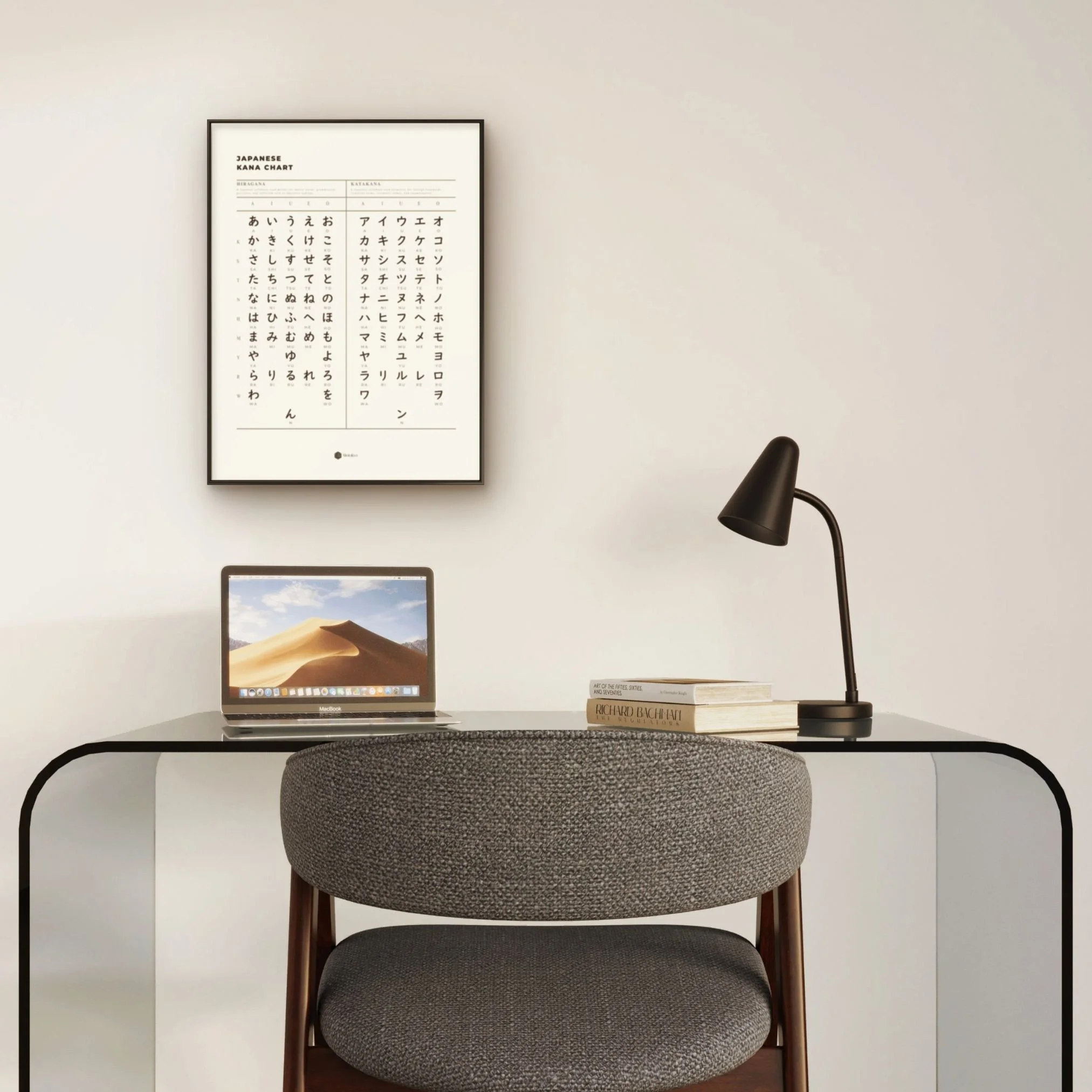
Learning kana gets easier when you see the characters regularly. If you’d like a simple reference to keep next to your desk, check out the Motokyo Japanese Kana Chart – Hiragana & Katakana Poster.
It puts Hiragana and Katakana side by side with Romaji, making it easy to reference the characters while you practice.