
 Image 1 of 3
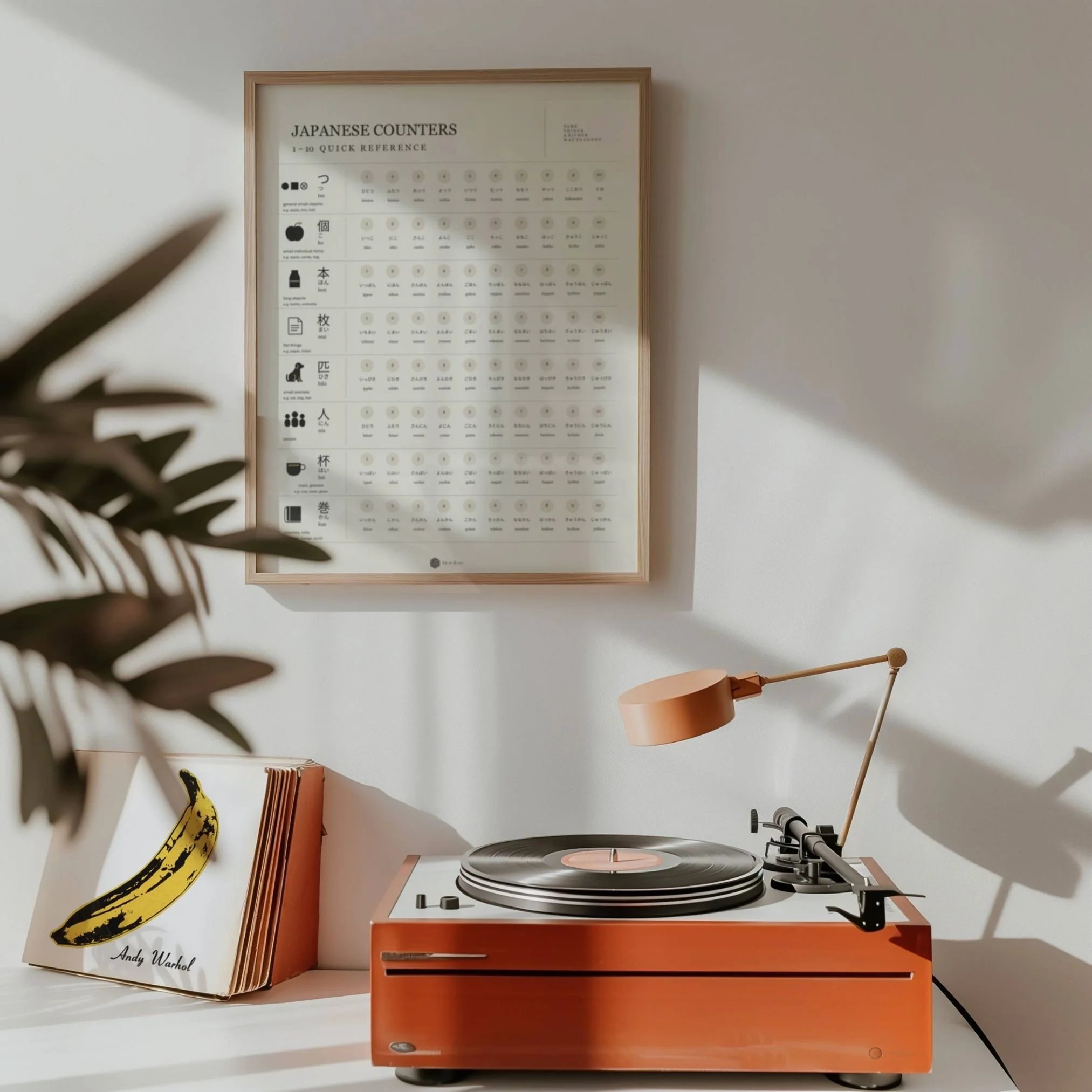 Image 2 of 3
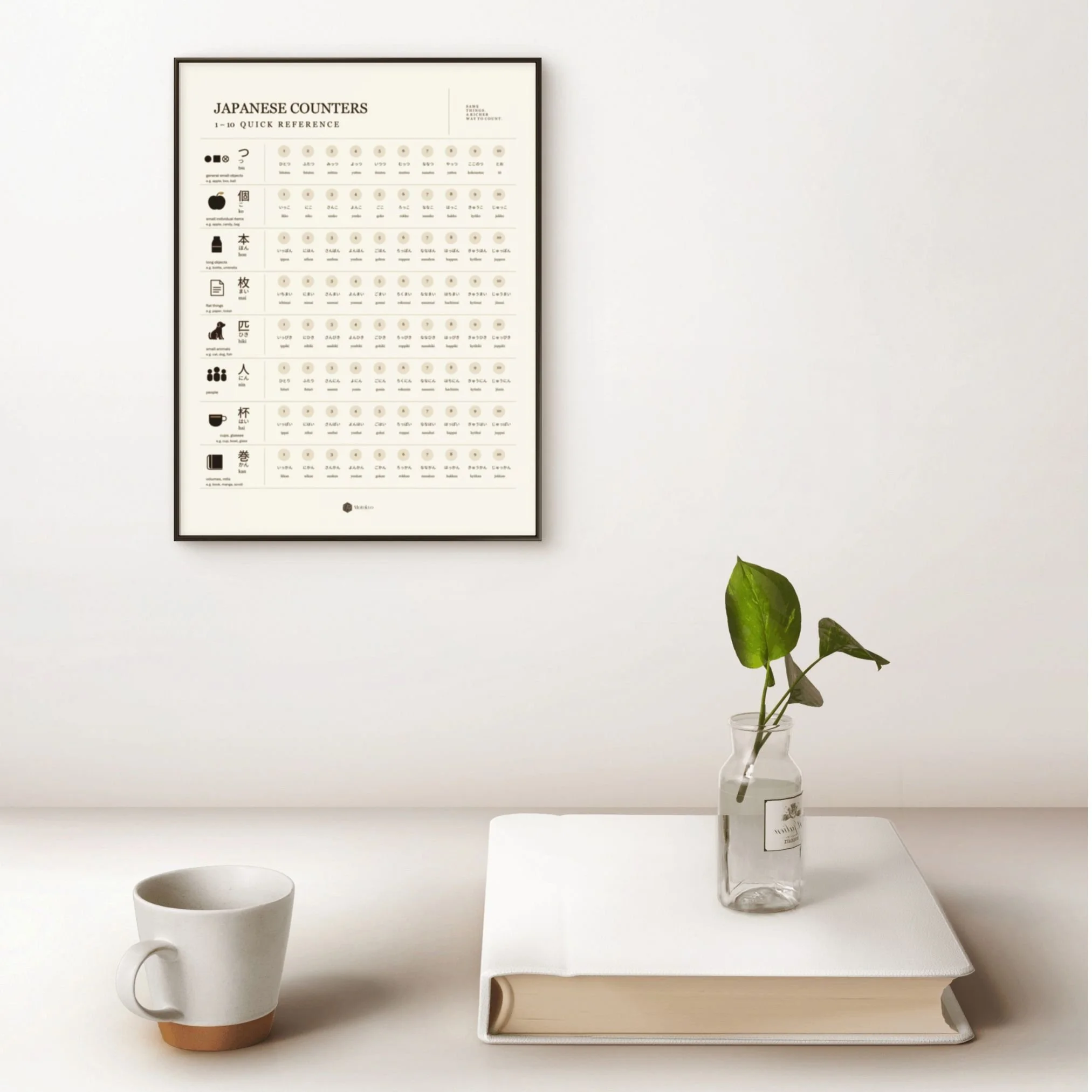 Image 3 of 3
Learning Japanese numbers is pretty simple. But once you start counting actual things, it gets a little more interesting.
One person is hitori. One book is issatsu. One bottle is ippon. Why are they all different?
Japanese uses different counters (助数詞 / josūshi) depending on what you’re counting.
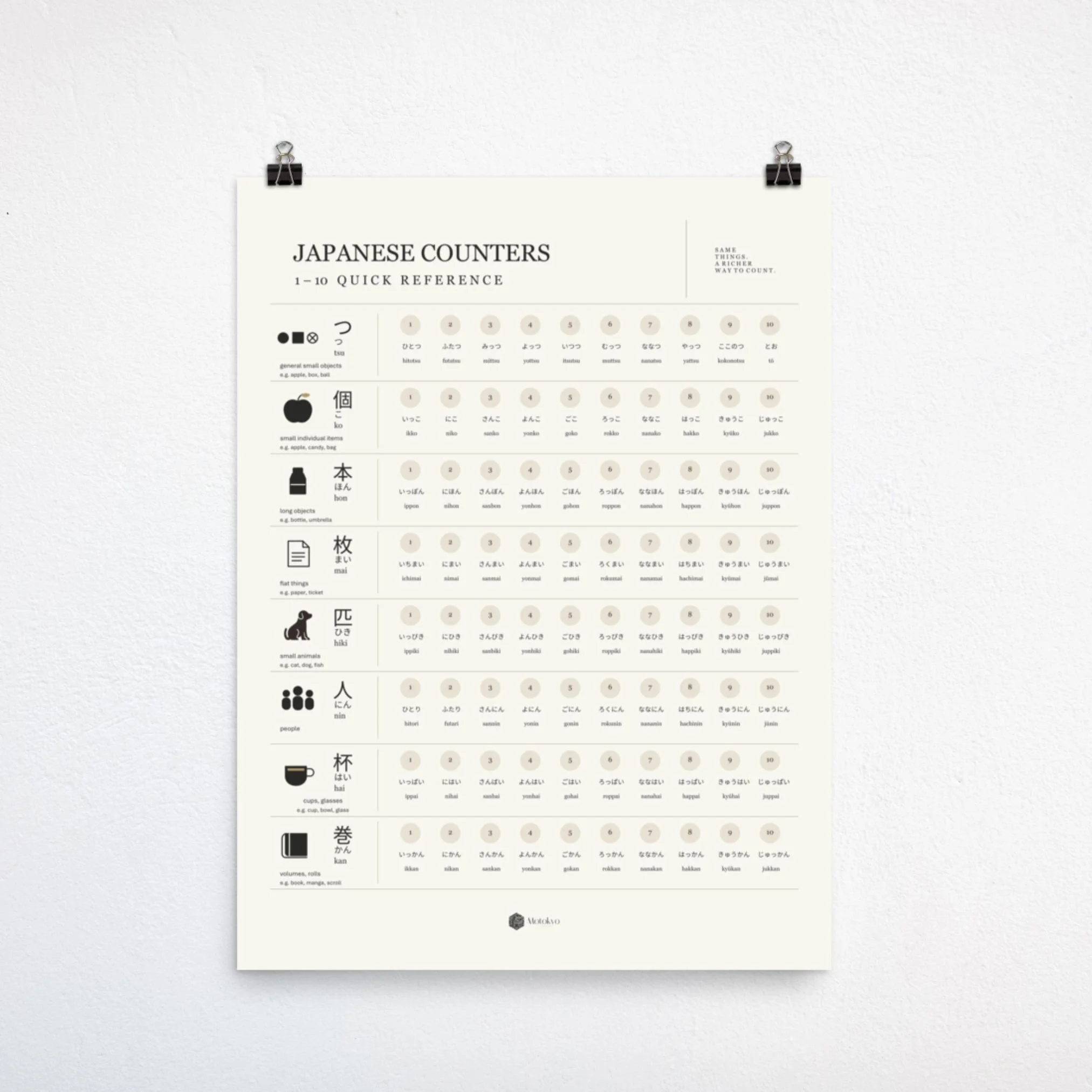
This illustrated poster breaks down some of the most useful Japanese counters with simple visuals, Japanese, Hiragana, and Romaji — making it easier to see how Japanese counting works at a glance.
It’s designed for Japanese learners, but also makes a clean, modern piece of Japanese-inspired wall art for a study space, classroom, or home.
You don’t need to memorize every Japanese counter at once.
Start with the ones you’ll actually see and use.
This poster introduces common ways to count everyday things such as people, animals, flat objects, long objects, books, small items, cups, and sushi.
Keep it near your desk while you study, use it as a quick reference, or simply let the examples become familiar over time.
18” x 24" or 24” x 36"
10 mil (0.25 mm) thick
Paper weight: 260 g/m²
Fingerprint resistant
Paper sourced from Japan, printed in USA
Designed by Motokyo
Free Shipping to USA, UK, Canada, Germany & Japan
Japanese language learners, students studying Japanese, Japanese teachers and classrooms, study rooms, Japan lovers, or anyone looking for a useful and modern Japanese learning poster.
Don’t try to memorize every Japanese counter and every pronunciation rule at once.
Start by learning common combinations as a set — like ippon, nihon, sanbon — and connect them with the things you actually use.
The more you see and hear them, the more natural they’ll start to feel.
Want to understand why Japanese counting works this way? Visit Motokyo’s How to Count Things in Japanese: A Simple Guide to Japanese Counters for examples, explanations, and a quiz to test yourself.
Learning Japanese numbers is pretty simple. But once you start counting actual things, it gets a little more interesting.
One person is hitori. One book is issatsu. One bottle is ippon. Why are they all different?
Japanese uses different counters (助数詞 / josūshi) depending on what you’re counting.
This illustrated poster breaks down some of the most useful Japanese counters with simple visuals, Japanese, Hiragana, and Romaji — making it easier to see how Japanese counting works at a glance.
It’s designed for Japanese learners, but also makes a clean, modern piece of Japanese-inspired wall art for a study space, classroom, or home.
You don’t need to memorize every Japanese counter at once.
Start with the ones you’ll actually see and use.
This poster introduces common ways to count everyday things such as people, animals, flat objects, long objects, books, small items, cups, and sushi.
Keep it near your desk while you study, use it as a quick reference, or simply let the examples become familiar over time.
18” x 24" or 24” x 36"
10 mil (0.25 mm) thick
Paper weight: 260 g/m²
Fingerprint resistant
Paper sourced from Japan, printed in USA
Designed by Motokyo
Free Shipping to USA, UK, Canada, Germany & Japan
Japanese language learners, students studying Japanese, Japanese teachers and classrooms, study rooms, Japan lovers, or anyone looking for a useful and modern Japanese learning poster.
Don’t try to memorize every Japanese counter and every pronunciation rule at once.
Start by learning common combinations as a set — like ippon, nihon, sanbon — and connect them with the things you actually use.
The more you see and hear them, the more natural they’ll start to feel.
Want to understand why Japanese counting works this way? Visit Motokyo’s How to Count Things in Japanese: A Simple Guide to Japanese Counters for examples, explanations, and a quiz to test yourself.