
You don’t need to speak Japanese to travel in Japan. But knowing just a little can make your trip much more fun.
Ordering food, shopping, asking for directions, or simply saying thank you can become small opportunities to connect with people.
Here are 10 essential Japanese phrases I recommend learning before your first trip to Japan.
Listen to each phrase, practice it a few times, and don’t worry about being perfect. Trying is more important than getting every sound exactly right.
10 Essential Japanese Phrases for Your Japan Trip
1. ありがとうございます
Arigatou gozaimasu
Thank you
🎧 Listen
When to use it
Use arigatou gozaimasu when someone helps you, serves you, gives you something, or does something kind for you.
You can use it at restaurants, hotels, stores, train stations, and just about anywhere else during your trip.
Cultural tip
This is a polite and very safe way to say thank you.
If you only remember a few Japanese phrases during your trip, make this one of them. You’ll probably have an opportunity to use it many times every day.
2. すみません
Sumimasen
Excuse me / Sorry
🎧 Listen
When to use it
Use sumimasen when you want to get someone’s attention, ask for help, pass by someone, or make a small apology.
If you want to ask a station employee a question, for example, simply start with:
すみません…
Sumimasen…
Excuse me…
Then ask your question.
Cultural tip
This is probably one of the most useful Japanese words for travelers.
Depending on the situation, it can mean “excuse me,” “sorry,” or even carry a feeling of “thank you for the trouble.”
When you don’t know how to start a conversation in Japan, sumimasen is often a great place to begin.
3. お願いします
Onegaishimasu
Please
🎧 Listen
When to use it
Use onegaishimasu when politely requesting something or asking someone to do something for you.
You’ll hear this expression constantly in Japan.
Cultural tip
English “please” and Japanese onegaishimasu don’t work exactly the same way.
Rather than simply adding “please” to every sentence, think of onegaishimasu as politely saying:
“I’m asking this of you.”
It’s an incredibly useful expression once you become comfortable using it.
4. これをください
Kore o kudasai
This one, please.
🎧 Listen
When to use it
This is one of my favorite phrases for first-time travelers because you don’t need to know the Japanese name of the thing you want.
Just point and say:
これをください。
Kore o kudasai.
This one, please.
You can use it with a menu, souvenir, ticket, food display, or almost anything else you can point to.
Cultural tip
Don’t worry about not knowing every Japanese word.
Pointing politely while saying kore o kudasai is completely practical.
Sometimes good communication is much more important than making a perfect sentence.
5. いくらですか?
Ikura desu ka?
How much is it?
🎧 Listen
When to use it
Use this phrase when shopping or whenever the price of something isn’t clear.
Simply point to the item and ask:
いくらですか?
Ikura desu ka?
Cultural tip
Most stores in Japan clearly display prices, but this is still useful at markets, smaller shops, food stalls, or anywhere several prices are displayed together.
Knowing the numbers in Japanese helps, but don’t worry if you don’t understand the answer. The person can often show you the price on a calculator, register, or phone.
6. トイレはどこですか?
Toire wa doko desu ka?
Where is the restroom?
🎧 Listen
When to use it
You can use this at train stations, restaurants, department stores, hotels, museums, sightseeing spots, and almost anywhere else.
Cultural tip
トイレ (toire) is the everyday word for toilet/restroom.
It’s also a useful Japanese word to recognize visually because you’ll see it on signs throughout Japan.
If you forget the whole sentence, even saying:
トイレ?
with a questioning tone will often communicate what you need.
7. 英語を話せますか?
Eigo o hanasemasu ka?
Do you speak English?
🎧 Listen
When to use it
This phrase is useful when you need more detailed help than your Japanese allows.
Cultural tip
Not everyone in Japan is comfortable speaking English—even if they studied it at school or understand some of what you’re saying.
It’s better to politely ask first rather than immediately speaking quickly in English.
And remember Moto’s Tip:
If they speak English, slow your English down too.
Use simple words. Avoid slang. Focus on the important information.
8. 〜に行きたいです
~ ni ikitai desu
I’d like to go to ~
🎧 Listen
When to use it
Put the name of your destination before ni ikitai desu.
For example:
東京駅に行きたいです。
Tokyo-eki ni ikitai desu.
I’d like to go to Tokyo Station.
This is useful in taxis, train stations, hotels, or when asking someone for directions.
Travel tip
If the name of your destination is difficult to pronounce, show the Japanese name on your phone and say:
ここに行きたいです。
Koko ni ikitai desu.
I’d like to go here.
Pointing + a simple phrase can be extremely effective.
9. いただきます
Itadakimasu
Said before eating
🎧 Listen
When to use it
Say itadakimasu just before you begin your meal.
You may see Japanese people briefly put their hands together while saying it.
Cultural tip
There isn’t a perfect English translation for itadakimasu.
The expression comes from いただく (itadaku), meaning “to receive humbly.”
It expresses appreciation for what you are about to receive—the food, the ingredients, and the people involved in preparing the meal.
So while it’s sometimes translated as “Let’s eat,” there’s more meaning behind it.
10. ごちそうさまでした
Gochisousama deshita
Thank you for the meal
🎧 Listen
When to use it
Say gochisousama deshita after you finish eating.
You can also say it to restaurant staff as you leave.
Cultural tip
This expression shows appreciation for the meal and the effort that went into preparing it.
Think of these two expressions as a pair:
Before eating:
いただきます
Itadakimasu
After eating:
ごちそうさまでした
Gochisousama deshita
Learning these two phrases also gives you a small introduction to the way appreciation is expressed around food in Japanese culture.
You Don’t Need Perfect Japanese
One of the biggest mistakes language learners make is waiting until they can say something perfectly before they actually use it.
When you travel in Japan, use what you know.
Start with:
すみません — Sumimasen
Speak slowly.
Point when you need to.
Use your phone when you need to.
And finish with:
ありがとうございます — Arigatou gozaimasu
That may be all you need.
Travel communication isn’t about having perfect grammar or a huge vocabulary. It’s about finding a way to understand each other.
A little Japanese can go a long way.
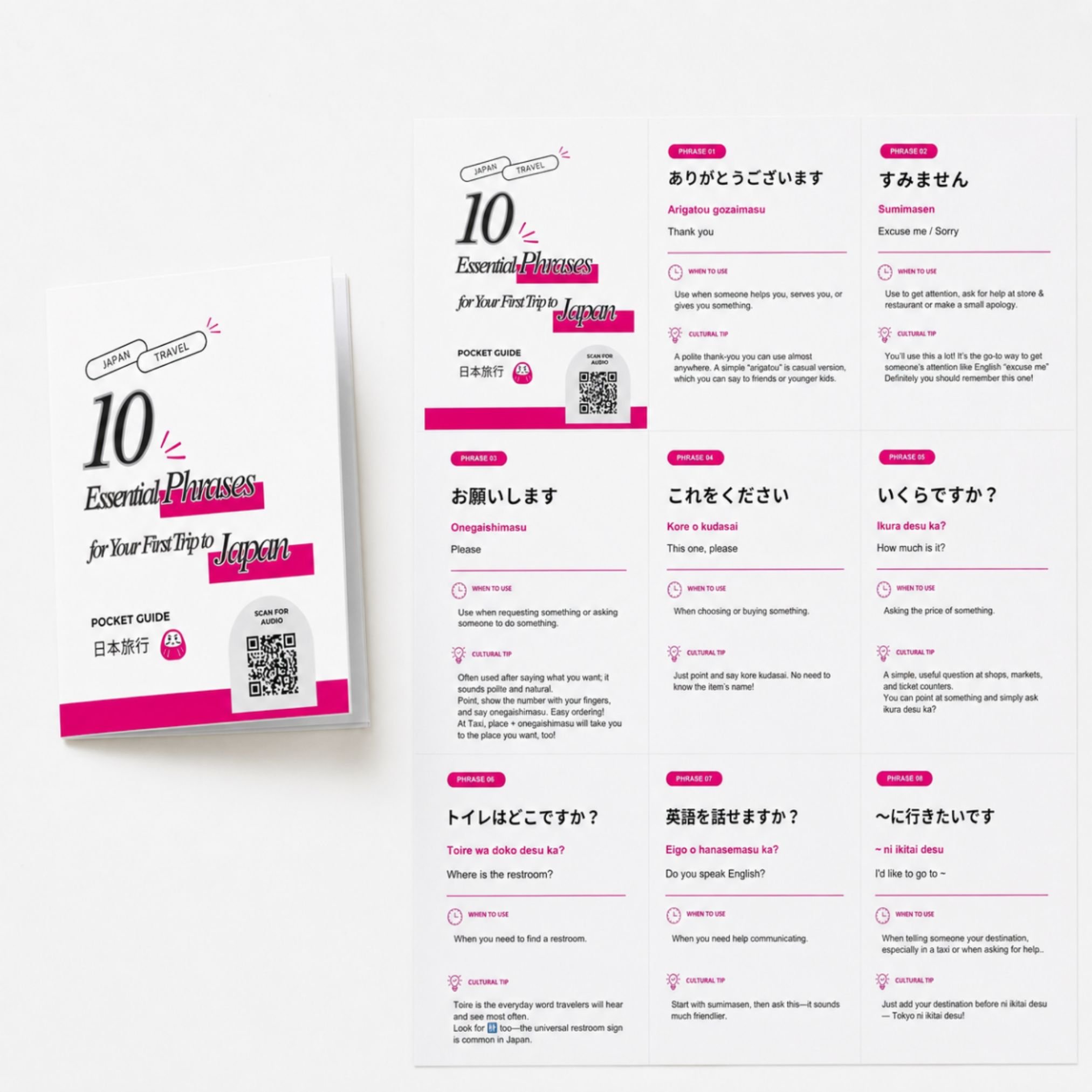
I summarized this in US letter size!
Take These 10 Phrases With You
Want to keep these phrases handy while you’re traveling in Japan?
I made a simple free printable pocket guide with all 10 essential Japanese phrases—easy to save, print, and take with you on your trip.
Enter your email below and I’ll send you the free guide.